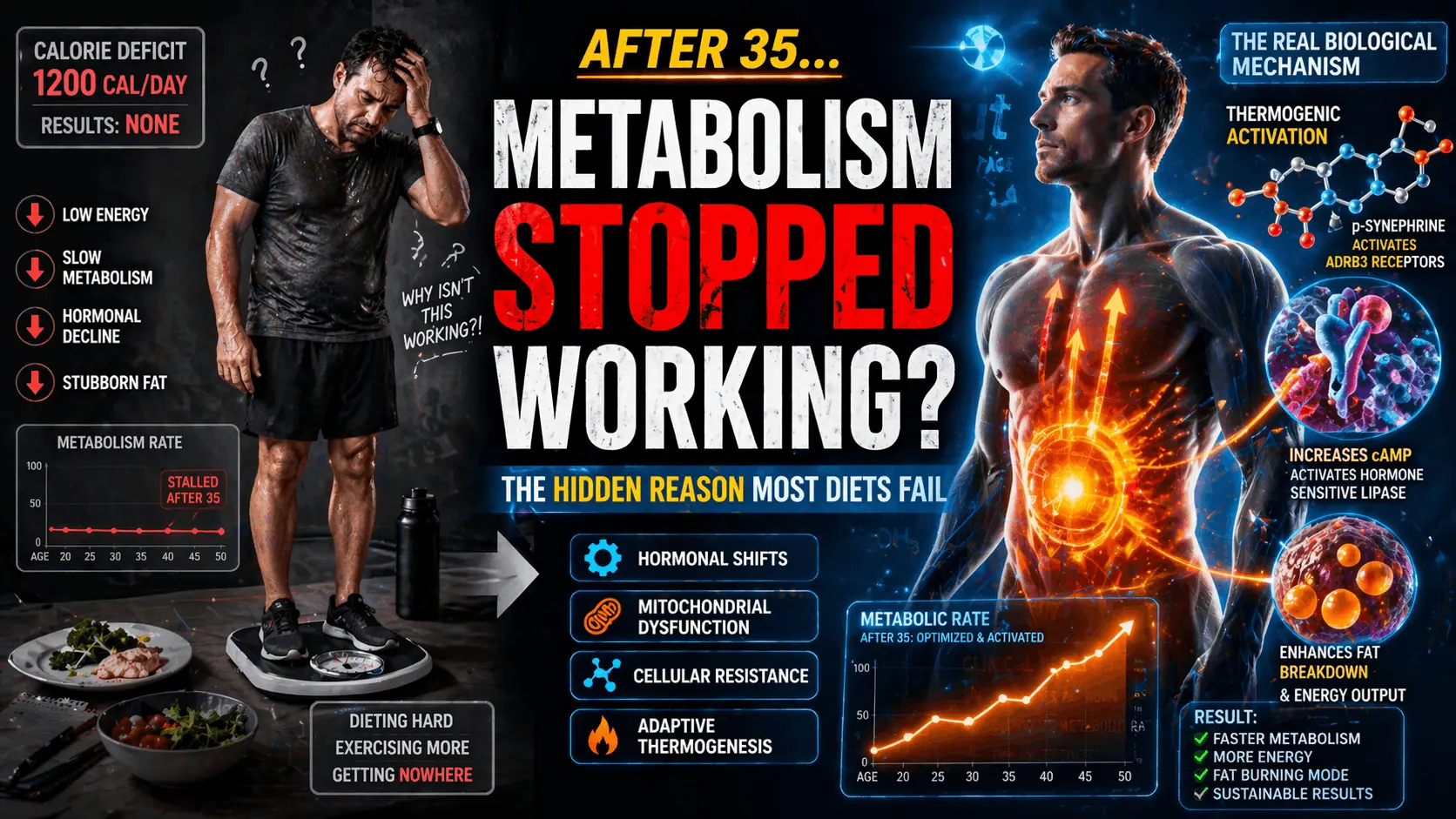
Most people who've been trying to lose weight for a while reach the same frustrating conclusion: the rules changed at some point, and nobody told them.
What worked at 28 — cutting carbs, adding cardio, watching portions — produces diminishing returns by 40. For many people, it produces no results at all. The standard response from the wellness industry is to blame willpower, consistency, or effort. But there's a more specific, more biological explanation that's been quietly building in the research literature over the past decade.
It's called thermogenic resistance. And understanding it changes how you think about metabolism entirely.
What Is Thermogenesis, and Why Does It Matter?
Thermogenesis is your body's internal heat production — the process by which calories are converted to energy and warmth rather than stored as fat. It's not a single process but a category: it includes the energy your body burns just to keep you alive (basal metabolic rate), the heat generated after eating (diet-induced thermogenesis), and the energy expended during movement and exercise (activity thermogenesis).
The critical number here is resting metabolic rate (RMR) — the calories your body burns at rest. For most people, this accounts for 60–70% of total daily calorie expenditure. Exercise, which most weight-loss plans obsess over, accounts for maybe 15–30% at best.
Key point: If your resting thermogenesis is impaired, no amount of exercise can fully compensate. A 45-minute workout might burn 300–400 calories. A suppressed metabolism might cost you 300–500 calories per day in reduced resting burn — which means you're running on a treadmill just to break even.
This is why the arithmetic of "eat less, move more" eventually breaks down for many people. It treats the body as a static equation when the equation itself is changing.
What Causes Thermogenic Resistance?
Thermogenic resistance refers to a condition where the body's mechanisms for activating thermogenesis become less sensitive or less functional. The result is that the same hormonal signals that once triggered fat burning now produce a weaker response — or sometimes almost no response at all.
Several factors contribute to its development:
1. Age-Related Hormonal Shifts
After 35 — and accelerating after 40, especially in women — levels of hormones like estrogen, testosterone, and growth hormone decline. These hormones play direct roles in maintaining brown adipose tissue (BAT), which is the body's primary thermogenic fat. As hormonal support drops, BAT activity decreases, and so does resting calorie burn.
Research has estimated that RMR declines by approximately 1–2% per decade after age 30, with the rate accelerating after menopause in women. This doesn't sound dramatic, but compounded over years with a largely static caloric intake, it adds up to significant weight accumulation even without any change in eating habits.
2. Chronic Dieting and Metabolic Adaptation
Here's the irony that many chronic dieters discover: the repeated cycles of caloric restriction that are supposed to produce weight loss can actually worsen thermogenic resistance over time.
The body interprets sustained caloric deficits as a survival threat and responds by downregulating thermogenesis — a phenomenon researchers call metabolic adaptation or adaptive thermogenesis. The longer and more frequently someone diets, the more efficient their body becomes at preserving fat stores during restriction. Studies have shown RMR reductions of 15–25% in people who've undergone significant caloric restriction, even after they return to normal eating. [Research ↗]
The uncomfortable truth: If you've been yo-yo dieting for years, you may have trained your metabolism to be more resistant to fat burning — not less. The problem isn't that you haven't tried hard enough. The problem is that trying harder using the same methods may have made the underlying condition worse.
3. Inflammation and Insulin Resistance
Chronic low-grade inflammation — common in people carrying excess visceral fat — impairs the signaling pathways that regulate thermogenesis. Insulin resistance, which affects roughly 1 in 3 American adults to some degree, further complicates the picture: impaired insulin signaling disrupts the body's ability to access and burn stored fat efficiently.
This creates a compounding feedback loop. More body fat generates more inflammation. More inflammation worsens insulin resistance. Worse insulin resistance reduces thermogenic efficiency. Reduced thermogenesis makes it harder to lose fat. And so on.
4. Sleep and Stress Hormones
Cortisol — the stress hormone — actively suppresses thermogenesis when chronically elevated. Poor sleep raises cortisol levels, reduces leptin (the satiety hormone), and increases ghrelin (the hunger hormone) simultaneously. People sleeping less than 6 hours per night show measurably impaired metabolic function compared to those getting 7–9 hours, independent of calorie intake. [Research ↗]
How Do You Know If You Have Thermogenic Resistance?
There's no single diagnostic test that a primary care physician will run for "thermogenic resistance" — it's a functional description more than a clinical diagnosis. But the pattern tends to be recognizable:
- Weight gain despite no significant change in eating habits
- Plateau or backward progress despite consistent exercise
- Persistent fatigue, especially in the afternoon
- Difficulty losing the last 20–40 pounds, even with serious effort
- Feeling cold more often than you used to
- A history of multiple rounds of caloric restriction / yo-yo dieting
- Weight gain accelerated after 40 or after menopause
If several of these apply, the weight management challenge you're experiencing likely has a metabolic, not motivational, root cause.
What Can Actually Break Through Thermogenic Resistance?
The research points toward a few legitimate approaches — and a lot of things that don't work.
What Doesn't Work (or makes things worse):
- Severe caloric restriction: Worsens metabolic adaptation. Short-term weight loss, long-term metabolic suppression.
- Ephedrine-class stimulants: Temporarily raise thermogenesis but carry cardiovascular risks and cause rebound suppression after discontinuation.
- Low-fat diets alone: Fat is required for multiple hormonal functions including those that regulate thermogenesis. Eliminating it without addressing the hormonal root cause doesn't help.
What the Evidence Supports:
Targeted botanical compounds. Certain natural compounds have been shown to activate thermogenesis through specific receptor pathways without the systemic risks of pharmaceutical stimulants. The most studied is p-synephrine from Seville orange peel, which acts on β-3 adrenergic receptors in adipose tissue specifically — meaning it triggers fat-cell thermogenesis without the cardiovascular stimulation of older compounds. [Study ↗]
EGCG (green tea catechins). These inhibit COMT, an enzyme that breaks down norepinephrine. By keeping norepinephrine active longer in fat tissue, EGCG extends the thermogenic signal. A meta-analysis across multiple randomized trials showed statistically significant effects on both weight and fat mass. [Meta-analysis ↗]
Capsaicinoids (from chili peppers). Activate TRPV1 receptors in the gut, which trigger a thermogenic response post-meal. Studies suggest increases in post-meal calorie expenditure of approximately 25%. [Study ↗]
Berberine. Activates AMPK — often described as the body's metabolic master switch — which regulates glucose uptake, fat oxidation, and mitochondrial function. Studies have shown effects comparable to metformin on blood glucose regulation in some populations, though more research is ongoing.
Adequate sleep and stress management. Not glamorous advice, but the cortisol-thermogenesis connection is direct and well-established. Metabolic improvements from botanical compounds are undermined by chronic sleep deprivation and high cortisol.
The combination effect matters: Most successful approaches to thermogenic resistance use multiple compounds that address different parts of the pathway simultaneously — fat-cell activation (p-synephrine), norepinephrine extension (EGCG), post-meal thermogenesis (capsaicinoids), and metabolic signaling (berberine). Single-ingredient approaches tend to produce smaller, less durable effects.
The Bottom Line
Thermogenic resistance is real, measurable, and increasingly well-documented in the metabolic research literature. It helps explain why the same strategies that worked for weight loss at 28 don't work at 42 — and why pushing harder with the same tools often makes things worse rather than better.
The meaningful interventions target the biological mechanisms directly: activating thermogenic receptors, extending fat-burning signals, improving metabolic signaling, and addressing the hormonal environment that determines whether your body burns calories or stores them.
Understanding this shifts the conversation from "why can't you stick to a diet" to "what is actually happening in your metabolism and what does the evidence say can address it." That's a much more productive starting point.