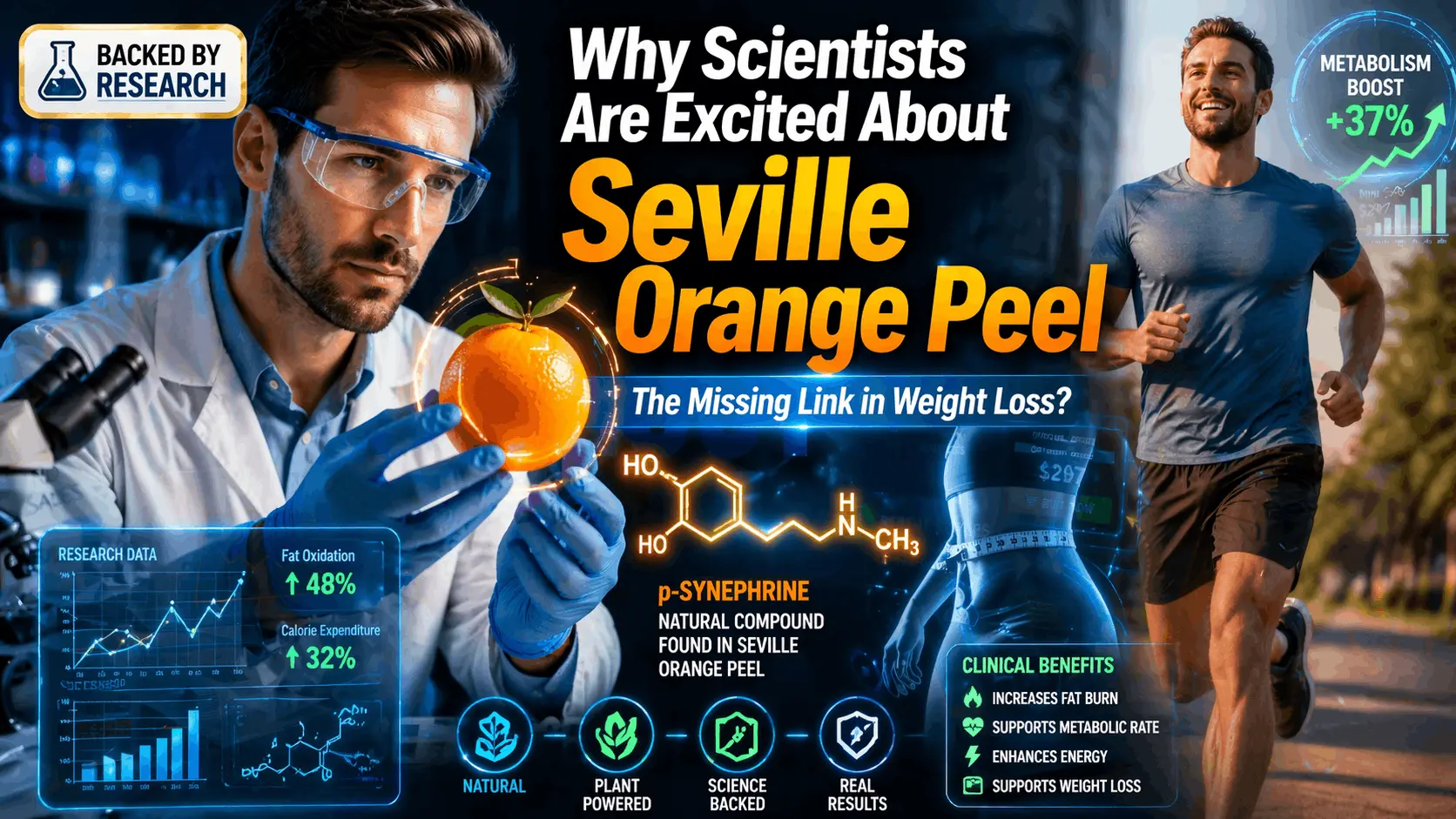
The story of metabolic supplements is largely the story of stimulants: compounds that force the body into a fat-burning state by flooding it with adrenaline-like signals. It works, briefly — and then comes the rebound, the tolerance, the cardiovascular risk, the ban.
Ephedrine was effective, then pulled from the US market in 2004 after documented heart events. Synephrine-based products that followed were often misformulated or combined with caffeine at doses that recreated the same risks. The problem was never the idea of thermogenic activation. The problem was how scientists were trying to achieve it.
Which is why the growing body of research on p-synephrine specifically — the primary active alkaloid in Seville orange peel — is drawing serious scientific attention. It activates thermogenesis through a different receptor pathway than ephedrine, one that's selective for fat tissue and far less stimulating to the heart and nervous system.
What Is P-Synephrine?
P-synephrine is a protoalkaloid found naturally in the peel of the bitter Seville orange (Citrus aurantium), a species of citrus grown primarily in southern Spain and the Mediterranean region. Unlike table oranges, Seville oranges are too sour to eat raw — they're traditionally used for marmalade and Spanish cooking. Their peel, however, contains a concentrated profile of synephrine alkaloids that have been the subject of pharmaceutical and nutritional research since the 1930s.
It's distinct from m-synephrine (also called oxilofrine), which does have cardiovascular effects and is banned by WADA in competitive sports. The "p" isomer — p-synephrine — has a different molecular configuration that changes how it interacts with adrenergic receptors throughout the body.
The key distinction: P-synephrine shows high affinity for β-3 adrenergic receptors, which are concentrated in adipose (fat) tissue, and low affinity for α-1, α-2, β-1, and β-2 receptors, which are the ones responsible for heart rate acceleration and vasoconstriction. This receptor selectivity is what separates it from ephedrine — and why the safety profile is so different.
What Does the Research Actually Show?
Let's be specific, because supplement claims are often more confident than the underlying evidence warrants. Here's what the peer-reviewed literature on p-synephrine actually demonstrates:
A systematic review of human clinical studies involving Citrus aurantium extract and p-synephrine found it increased resting metabolic rate and supported thermogenesis without significant adverse cardiovascular effects at recommended doses. The reviewers noted that p-synephrine alone, at doses studied, did not produce measurable increases in heart rate or blood pressure. [Read Study ↗]
An earlier review examining the use of Citrus aurantium and synephrine alkaloids in overweight and obese populations found favorable evidence for thermogenic effects, though authors noted that many existing products combined p-synephrine with caffeine, making it difficult to isolate the compound's independent contribution. When studied in isolation, safety signals were notably cleaner than ephedrine-class compounds. [Read Study ↗]
A double-blind, placebo-controlled safety study specifically designed to evaluate Citrus aurantium extract over 60 days found no adverse effects on blood pressure, heart rate, or cardiac function. The study used clinically relevant doses and represents one of the more rigorous safety assessments of this compound in the literature. [Read Study ↗]
This study examined acute cardiovascular effects of p-synephrine alone and in combination with caffeine. P-synephrine alone produced no significant changes in heart rate or blood pressure. When combined with caffeine, there were modest, transient increases — suggesting that the stimulant effects seen in many products may be attributable to caffeine rather than p-synephrine itself. [Read Study ↗]
P-Synephrine vs. Other Thermogenic Approaches
To put the research in context, here's how p-synephrine compares to the other main thermogenic strategies that have been studied or marketed:
| Compound | Thermogenic Effect | Cardiovascular Safety | Legal / Available | Stimulant Rebound |
|---|---|---|---|---|
| Ephedrine | Strong | High Risk | Banned (OTC) | Yes |
| High-dose Caffeine | Moderate | Moderate Risk | Legal | Yes |
| M-Synephrine (Oxilofrine) | Moderate | Significant Risk | WADA Banned | Partial |
| P-Synephrine (Seville Peel) | Targeted | Strong Safety Record | Legal & Natural | Not Observed |
| Green Tea EGCG | Moderate | Excellent | Legal & Natural | Not Observed |
The picture that emerges is that p-synephrine occupies a unique position: meaningful thermogenic activity, a safety profile that holds up to scrutiny, and no dependence or rebound. That combination is rarer than it sounds in the metabolic supplement space.
The Receptor Mechanism — Why β-3 Selectivity Matters
This is where the science gets interesting, and it's worth understanding even at a simplified level.
Adrenergic receptors are proteins on cell surfaces that respond to adrenaline and noradrenaline. There are several subtypes, each with different roles:
- β-1 receptors: Predominantly in the heart — activation raises heart rate and force of contraction
- β-2 receptors: In the lungs and smooth muscle — activation causes bronchodilation
- α-1 / α-2 receptors: In blood vessels — activation causes vasoconstriction (raised blood pressure)
- β-3 receptors: Predominantly in adipose (fat) tissue — activation triggers lipolysis and thermogenesis in fat cells
Ephedrine is a non-selective agonist — it activates all of these, which is why it burns fat AND raises blood pressure, heart rate, and creates the full stimulant response. P-synephrine, by contrast, shows pronounced preference for β-3 receptors. The practical result: it tells fat cells to start burning without sending the same distress signal to the cardiovascular system.
The analogy: Ephedrine is like shouting into a PA system that broadcasts to the entire building. P-synephrine is like sending a direct message only to the basement (where the furnace is). Same instruction — burn more — but sent to a much more targeted audience.
This selectivity also explains why p-synephrine doesn't produce tolerance the way stimulants do. Tolerance to stimulants develops because the nervous system downregulates receptor sensitivity to protect itself from overstimulation. P-synephrine's primary action is peripheral (in fat tissue), not central (in the brain and nervous system), so the desensitization mechanism doesn't engage in the same way.
What Potentiates P-Synephrine?
Research and clinical experience suggest p-synephrine's effects are amplified by several compounds that act on related pathways:
EGCG from Green Tea
While p-synephrine activates β-3 receptors to trigger fat-burning, EGCG extends the signal by inhibiting COMT — the enzyme that breaks down norepinephrine. More norepinephrine in circulation means the thermogenic signal lasts longer. The two compounds work in sequence: one turns the switch on, the other prevents it from turning off. [Study ↗]
Capsaicin (Red Pepper)
Activates a completely different mechanism — TRPV1 receptors in the gut — to generate post-meal thermogenesis. This is additive, not redundant, because it adds a meal-specific calorie burn on top of the baseline resting thermogenesis that p-synephrine supports.
Ginger (Gingerols and Shogaols)
Works downstream of the thermogenic process by improving insulin sensitivity and reducing appetite hormone dysregulation. This matters because insulin resistance impairs the body's ability to access and burn the fat that thermogenic activation mobilizes.
Berberine
Activates AMPK — sometimes called the metabolic master switch — which regulates how cells process glucose and fat. Berberine essentially improves the metabolic environment in which p-synephrine operates, making the fat-burning signal more productive.
The combination logic behind a formula like CitrusBurn™ is that p-synephrine alone, at safe doses, produces moderate thermogenic effects. Stack it with compounds that extend the signal, add parallel thermogenic pathways, improve insulin sensitivity, and modulate appetite hormones — and you get a meaningfully different metabolic environment than any single compound could create.
What P-Synephrine Cannot Do
Honest assessment requires being clear about the limitations:
- P-synephrine is not a substitute for a caloric deficit. It increases calorie burning, but if you're eating significantly more than you're burning, the thermogenic increase won't overcome that gap entirely.
- The effects are not instant or dramatic. They're cumulative — supporting a slightly elevated metabolic rate over weeks and months, which adds up significantly but doesn't produce overnight results.
- Individual response varies. People with already active metabolisms will see less dramatic effects than those with significant thermogenic resistance.
- Quality and dosage matter enormously. Much of the supplement industry uses doses too low to produce measured effects — or extracts standardized to the wrong alkaloid profile.
Bottom line on p-synephrine: The compound is one of the better-validated natural thermogenic agents available, with a safety record that has held up over multiple independent safety studies. It's not a miracle compound — but in a properly formulated blend targeting multiple metabolic pathways, it represents a scientifically credible foundation for metabolic support without the tradeoffs that have plagued stimulant-based approaches.
Why 2026 Is Different
Research on p-synephrine has been building for two decades, but several factors have converged recently to push it into mainstream scientific discussion:
First, the weight-loss drug landscape has shifted dramatically. GLP-1 agonists like semaglutide have demonstrated powerful results, but they're expensive, require prescriptions, carry significant gastrointestinal side effects, and produce dramatic muscle mass loss alongside fat loss in many users. A large population of people are looking for effective natural alternatives — and the scientific bar for what qualifies as "effective" has risen accordingly.
Second, the safety literature on p-synephrine has matured. There are now multiple independent, placebo-controlled safety studies with consistent findings. The risk profile is increasingly well-characterized, which makes regulatory bodies and formulators more comfortable working with it at tested doses.
Third, understanding of thermogenic resistance has improved (see our companion article), which provides a clearer mechanistic rationale for why compounds like p-synephrine matter for a specific population — particularly those over 35 who are experiencing the age-related metabolic shifts the research describes.