- Sign 1: Gaining Weight on the Same Calories
- Sign 2: Feeling Cold All the Time
- Sign 3: Daily Afternoon Energy Crashes
- Sign 4: Weight Loss Permanently Plateaued
- Sign 5: Constant Carb and Sugar Cravings
- Sign 6: Hair Loss, Brittle Nails, Dry Skin
- Sign 7: Exercise Makes You More Exhausted
- Why Metabolic Damage Happens
- 6 Natural Ways to Fix It
- How Long Recovery Takes
Most people who cannot lose weight have been told the same thing: eat less, move more, try harder. What they are rarely told is that years of caloric restriction and yo-yo dieting can physically alter metabolism in ways that make weight loss genuinely harder — not because of motivation, but because of measurable biological changes.
Here are the seven most reliable signs that your metabolism has been damaged — and what the research says you can do to repair it.
The 7 Signs of a Damaged Metabolism
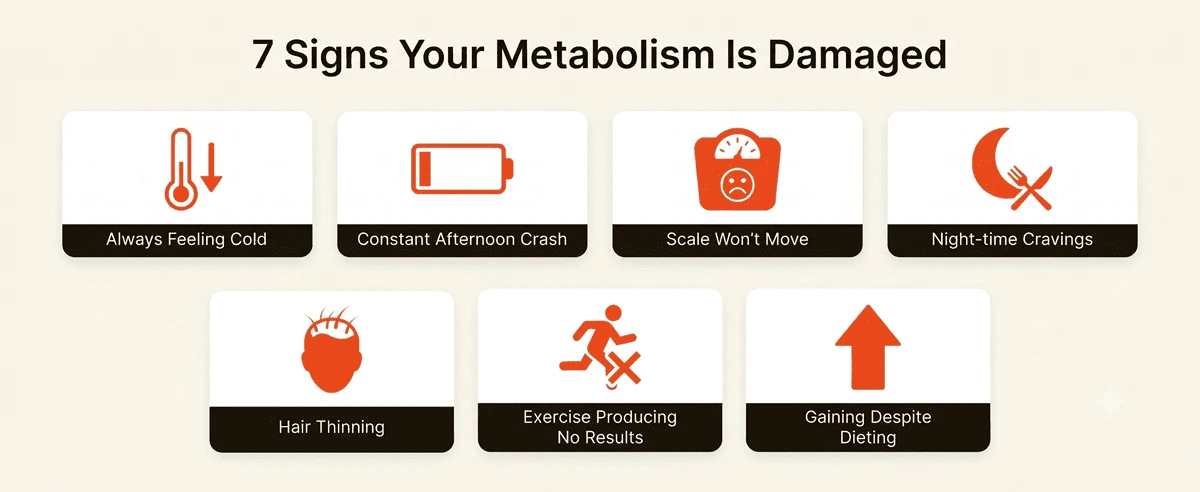
This is the most direct indicator. If your eating habits have not changed significantly but you are slowly gaining weight year over year, your resting metabolic rate has dropped. Research shows that each decade after age 30, resting energy expenditure decreases by approximately 1–2% — and this rate accelerates significantly after multiple rounds of caloric restriction. Your body has recalibrated its maintenance threshold downward, meaning the same food intake now represents a surplus rather than maintenance. [Research ↗]
Thermogenesis is your body's internal heat production. When metabolic rate drops, heat output drops with it. Feeling consistently cold — particularly in the extremities — is a direct physical signal that your thermogenic output has decreased. Brown adipose tissue (BAT), the body's primary heat-generating fat, becomes progressively less active as metabolic function declines with age and repeated dieting cycles. Cold intolerance that worsens over years is rarely normal — it is usually a metabolic signal.
A consistent energy crash between 2–4pm is strongly associated with blood sugar dysregulation and impaired metabolic flexibility — the ability to switch between burning carbohydrates and fat as fuel sources. A metabolically healthy person transitions between fuel sources smoothly. A metabolically damaged one becomes dependent on glucose, experiencing hard crashes every time blood sugar dips between meals because the fat-burning backup system is not functioning properly.
This is adaptive thermogenesis — one of the most well-documented phenomena in obesity research. When you restrict calories significantly, your body reduces its metabolic rate to match. Studies of participants from "The Biggest Loser" television programme showed that six years after the competition, resting metabolic rates remained suppressed by an average of 500 calories per day below predicted levels — even in participants who had regained all their original weight. The metabolic suppression outlasted the weight loss by years. [Study ↗]
Persistent carbohydrate cravings — particularly in the evening — indicate disrupted leptin and ghrelin signaling. Leptin is the hormone that tells your brain you are full. When metabolic function is impaired, leptin resistance develops: your brain stops receiving the satiety signal properly. The result is a chronically elevated hunger drive, particularly for fast-burning carbohydrates that quickly raise blood glucose. This is not poor willpower — it is a hormonal signaling failure driven by metabolic dysfunction.
These symptoms overlap significantly with thyroid dysfunction, which is directly connected to metabolic rate. Your thyroid produces T3 and T4 hormones that regulate how fast every cell in your body burns energy. Metabolic suppression from chronic dieting can impair thyroid hormone conversion — producing subclinical hypothyroid-like symptoms even when standard TSH blood tests return "normal." Hair loss, brittle nails, and dry skin are classic downstream effects of reduced cellular energy availability. [Research ↗]
When metabolic function is impaired, high-intensity exercise can paradoxically worsen the situation by raising cortisol — which further suppresses thermogenesis and promotes abdominal fat storage. If you are exercising consistently but feeling depleted rather than energized afterward, and your body composition is not changing despite the effort, metabolic dysfunction is very likely interfering with the recovery and adaptation process that exercise depends on.
Having 3 or more of these signs simultaneously strongly suggests metabolic adaptation rather than lack of effort. The solution is not to push harder with the same strategies — it is to address the biological mechanisms directly. Continuing to restrict calories and increase exercise in this state often worsens metabolic suppression rather than resolving it.
Why Metabolic Damage Happens
Adaptive Thermogenesis from Caloric Restriction
Every time you significantly restrict calories, your body downregulates metabolic rate to match the reduced intake. This is a survival mechanism — your body interprets sustained caloric deficit as famine and responds by becoming more efficient. Each cycle of restriction and refeeding tends to leave metabolic rate slightly lower than before — a ratcheting effect that compounds significantly over years of yo-yo dieting.
Loss of Brown Adipose Tissue Activity
BAT is the most metabolically active tissue in the human body — it exists specifically to burn calories as heat. BAT activity decreases with age, with obesity, and with chronic caloric restriction. Once BAT becomes less thermogenically active, resting calorie burn drops measurably and the body loses its primary heat-generating mechanism.
Hormonal Cascade Disruption
Leptin, ghrelin, insulin, cortisol, and thyroid hormones interact in a complex cascade to regulate metabolic rate. Chronic dieting, poor sleep, chronic stress, and aging all disrupt this cascade in ways that take months to correct — and that caloric restriction alone cannot fix, because restriction itself is one of the primary disruptors.
The core problem with conventional advice: Most weight loss guidance treats metabolism as a fixed equation — eat less than you burn, lose weight. But a metabolically damaged body responds to restriction by reducing its burn rate to match. The equation itself changes. You cannot solve a variable equation by only controlling one side of it.
6 Natural Ways to Repair a Damaged Metabolism
Compounds like p-synephrine (Seville orange peel), EGCG (green tea), and capsaicin directly activate thermogenic pathways without the cortisol-raising effects of stimulants that worsen metabolic suppression.
Evidence: Strong7–9 hours of quality sleep normalizes cortisol, leptin, and ghrelin simultaneously. Sleep deprivation alone reduces metabolic rate by 5–20% — eliminating most of the benefit of exercise.
Evidence: Very StrongProtein has the highest thermic effect of any macronutrient — 20–30% of its calories are burned in digestion. It also preserves lean muscle mass, the primary driver of resting metabolic rate.
Evidence: StrongResistance training rebuilds metabolically active lean muscle. High-cortisol cardio in a metabolically suppressed state worsens the hormonal environment. Strength training improves it.
Evidence: StrongCounterintuitive but well-documented: a 2–4 week period at maintenance allows adaptive thermogenesis to normalize. Research shows this improves long-term fat loss outcomes vs continuous restriction.
Evidence: Moderate-StrongCortisol is one of the most powerful suppressors of thermogenesis. Measurable reductions in cortisol from stress management directly improve the metabolic environment for fat burning.
Evidence: StrongHow Long Does Metabolic Recovery Take?
This is the question most people want answered honestly. The reality depends on how long the damage accumulated:
| Level of Damage | History | Realistic Recovery Timeline |
|---|---|---|
| Mild suppression | 1–2 years of moderate dieting | 2–3 months of targeted support |
| Moderate damage | 3–5 years of yo-yo dieting | 4–6 months consistent effort |
| Significant adaptation | 10+ years chronic restriction | 6–12 months; some permanent but compensable |
The critical insight: Metabolic repair is a biological process that takes months — not a problem that responds to pushing harder in the short term. The people who recover fastest are those who stop fighting their metabolism with more restriction and start supporting it with the right biological inputs.
CitrusBurn™ Targets These Metabolic Mechanisms Directly
7 botanicals selected to address thermogenesis, cortisol regulation, appetite hormones, and AMPK activation simultaneously. Non-stimulant. Non-habit forming. 180-day money-back guarantee.
See CitrusBurn™ →Want the Full CitrusBurn™ Picture?
Our homepage has complete pricing, all testimonials, ingredient deep-dive, and the current discount — everything in one place.